FR/EN
Heritage renovation · Paris
Protected period structures, grand staircases, courtyard façades: renovating an hôtel particulier demands heritage mastery and faultless project leadership. One contract, from first study to handover of the keys.
Why W.A.R.D
Timber and stone structures, original decors, change of use: our method was forged on some of the most demanding heritage projects in Paris — including a major 227 m² transformation with sixteen trades.
Our own ten-year warranty insurance covers each project in full, structural repairs included. On a century-old building, this cover is no detail: it is the condition of your peace of mind.
General contractor: design, permits, execution and the coordination of every trade under one contract. One responsible party, one committed budget, one handover date.
References
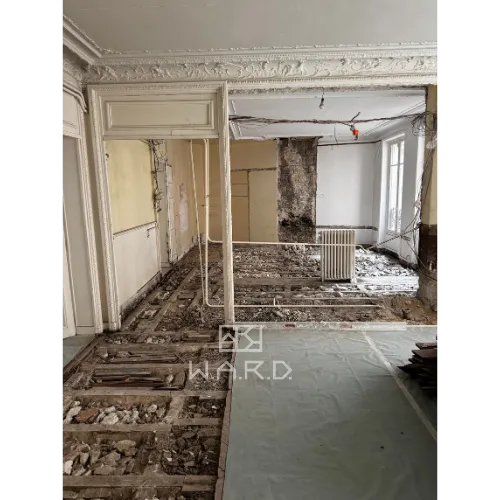
Let us say it plainly: W.A.R.D does not claim to have already delivered an hôtel particulier. What we have delivered is more demanding than it may appear — major renovations of Paris's heritage building stock, including the complete transformation of Le Trocadéro: 227 m² of Haussmann interiors, a change of use (a law firm returned to residential life), ten months on site and sixteen trades coordinated under a single contract. Or Le St Georges, 145 m² of heritage fabric in the 9th arrondissement. Historic timber structures, stone walls, original decors to be restored rather than remade, services entirely renewed without harming anything of what gives the place its value: these are exactly the skills an hôtel particulier requires. The difference is a matter of scale and regulation — not of nature. And absorbing that additional complexity is precisely the role of a general contractor.
A project of this kind? Tell us about it in a few lines: we come back to you within 48 hours with a first reading — scope, order of magnitude, realistic timeline.
And where the project warrants it, we come to you: a free on-site advisory visit, with no commitment, to tell you what is feasible before you commit to anything.
Many Parisian hôtels particuliers are listed or classified as historic monuments, or stand within a protected heritage site — in the Marais, the Faubourg Saint-Germain, the 8th or the 16th arrondissement. Each status carries its own regime of permissions: planning permission or prior declaration, binding or advisory opinion of the Architectes des Bâtiments de France for any intervention visible from the public realm, prescriptions on materials and workmanship. These procedures run to their own timetables; we build them into the schedule from the design stage so that they never become the critical path of the project.
A stone staircase of honour with its wrought-iron balustrade, ceiling heights of four metres and more, period panelling, ornamental plasterwork, fireplaces and parquet floors: these elements make the value of the property and dictate the method. Full protection throughout the works, restoration by specialist artisans rather than replacement, scaffolding and lifting equipment suited to the volumes — so many line items a serious estimate must anticipate, and which our coordination of all trades integrates natively.
The hôtel particulier differs from the apartment building by its complete envelope: street and courtyard façades, roof, paved courtyard, sometimes a garden. Façade restoration, repair of zinc or slate roofing, restoration of the external joinery, treatment of downpipes and buried services: the building envelope falls within the scope of the project, with all the scaffolding and public-domain occupation constraints that implies in the heart of Paris.
Many hôtels particuliers were converted into offices, embassies or head offices over the course of the twentieth century. Returning them to residential use — or the reverse — entails a change of use and often a change of planning destination: urban-planning permissions, upgrading of the services, sometimes compensation. We have carried this procedure through from end to end on Le Trocadéro — precisely a return to residential use after decades of office occupation.
Inserting a private lift into an old stairwell without disfiguring the volumes, concealing air conditioning and ventilation in a building never designed for them, installing access control, alarm and CCTV to the standard the owners expect, wiring the whole for home automation: such is the art of contemporary heritage renovation — twenty-first-century comfort within an eighteenth- or nineteenth-century envelope, with nothing on show.
An hôtel particulier is not renovated like an apartment: the order of operations determines the budget and the result. A complete survey first — measured drawings, structural investigations, asbestos and lead surveys, the condition of floors, façades and roof. Then design and permissions: plans, choice of materials, planning files and exchanges with the ABF where required. The building envelope next: roof, façades, external joinery — there is no point beginning the finishes beneath a tired roof. Then come structure and services: floor repairs, new openings, new electrical, plumbing, heating and ventilation. Finally, the finishes and the restoration of the decors: plastering, panelling, parquet, painting, custom millwork. Each phase is milestoned, priced and approved before the next begins.
One contract, one responsibility. Architects, master artisans, the firms of the sixteen trades, administrative procedures: as a general contractor, we carry the whole under a single contract — committed price, committed deadline, €5,000,000 ten-year warranty insurance. On a project of this scale, unity of command is not a comfort: it is the condition of the result.
On an hôtel particulier, the trades number in the dozens: masons and stonecutters, carpenters, roofers, metalworkers, ornamental plasterers, cabinetmakers, parquet layers, electricians, plumbers, heating engineers — joined by the decorative crafts for the decors. Our value lies there: a dedicated site manager orchestrates these interventions to a contractual schedule, arbitrates quickly when the building springs a surprise (on a century-old structure, that is part of the journey), and keeps you informed at a regular rhythm without your ever having to manage a single contractor. At handover, the entire works are covered by our €5,000,000 ten-year warranty insurance, alongside the statutory guarantees of perfect completion and proper functioning.
As for budget, the ranges observed on the Paris market run from €1,000 to €1,200 per m² for a refresh, €1,800 to €2,200 per m² for a careful full renovation, €2,400 to €2,800 per m² for high-end heritage work and over €3,000 per m² for exceptional projects — the natural territory of the hôtel particulier. Outside the grid, on top: custom joinery and millwork add €500 to €700 per m² for a full project (around €600 on average); design (architecture and interior design) is billed separately. Our price guide to historic Parisian buildings details these orders of magnitude line by line. For a precise estimate of your project, describe it to us: an answer within 48 hours, and all of our heritage work is to be discovered in the portfolio.
FAQ
An hôtel particulier almost always belongs to the high end: €2,400 to €2,800 per m², and even over €3,000 per m² for exceptional projects, depending on the condition of the building and the heritage constraints. A partial refresh runs from €1,000 to €1,200 per m², a careful full renovation from €1,800 to €2,200 per m². Only a line-by-line estimate after a site visit is authoritative — request yours.
Often, yes: within a protected heritage site or near a listed monument, any intervention visible from the public realm — façades, roofs, external joinery — requires the opinion of the ABF. We build these procedures into the schedule from the design stage.
Our expertise comes from Paris's heritage building stock: the major transformation of Le Trocadéro (227 m², change of use, 16 trades) and Le St Georges (145 m² of Haussmann interiors). It is these very skills that we transpose to hôtels particuliers.
Our own ten-year warranty insurance covers each project up to €5,000,000, alongside the statutory guarantees of perfect completion and proper functioning. Price and deadline are contractually committed.
"Many thanks to Anthony and his team for their professionalism, their advice and the quality of the work. The result is refined and exactly what I expected." (translated)Adrien A. · Google review
Read the reviews →Describe your project — an answer within 48 hours →
Just a question? Write to us — answer within 48 h, no commitment.